 VPSbit
Best Anonymous VPS for Europeans — EU Latency Map
Europeans ranked: Zurich or Reykjavik primaries with EU replicas, one Saint Kitts contract, Monero billing — Core from $4.80 annual-eff.
Europeans ranked: Zurich or Reykjavik primaries with EU replicas, one Saint Kitts contract, Monero billing — Core from $4.80 annual-eff.
12 locations · 19 coins · SLA 99.95% · no KYC · public canary
VPS from $4.80* — Core on the annual term (list $6/mo), one invoice for 12 months, no auto-charges. Dedicated with IPMI from $39.20/mo. Crypto invoice, no KYC.
Launch nowHow this European edition was scored
European buyers carry a scoring burden that shoppers in other regions never face, so this ranking runs on its own sheet instead of borrowing the global one. Four axes do the work, and each keeps its own column: the legal regime actually binding the building, the round-trip time from Europe's population centers, the paperwork demanded at the door, and the money rails that decide whether a bank-side dossier ever opens. You can read every cell against its source, because the grid names where each figure came from. Adjectives carry no weight here; published policies and numbers carry all of it.
- Courts first: the regime binding each building, weighted heaviest
- Milliseconds second: round-trip time from Europe's population centers
- Paper trail third: documents demanded at signup
- Rails fourth: coins, cards and the bank-side trace
The weight order is printed so you can rerun it yourself: courts first, milliseconds second, the paper trail third, the rails fourth. Europeans rarely choose where their users live, which fixes law and speed as the standing costs of any deployment, while identity handling and billing are the two axes where sellers actually separate from one another. Disagree with the ordering and the grid below still backs your re-run, because every row names its source and this page carries its own revision date. Nothing here depends on loyalty or taste.
One disclosure belongs at the top, not the bottom: VPSbit publishes this page, and the entity behind it is Meridian Node Ltd. of Saint Kitts and Nevis. Competing rows carry only what those shops publish about themselves — city lists, screening posture, payment methods — with no currency arithmetic and no charitable readings of brochures. Where a seller in this niche publishes almost nothing, the cell says so plainly rather than wearing a flattering guess. You are placing real money, and the grid should inform you rather than charm you.
One structural fact does half the work on this sheet: the contract and the hardware live under different skies. VPSbit bills from Saint Kitts and Nevis while the compute sits in twelve flagship cities, eight of them in or beside Europe — Amsterdam, Frankfurt, Luxembourg, Zurich, Stockholm, Helsinki and Oslo inside or alongside the Union, plus Reykjavik just outside it. The bill answers to one legal system, the machine to another, and neither pretends otherwise. Everything else in the method mirrors the main ranking, so you can read the two tables side by side.
The split Europeans actually buy: Union iron, offshore paper
Aimed at companies, GDPR is a genuine weapon for you as an individual — access rights, deletion rights, fines with teeth. Between governments, thick intelligence pacts remain the norm, and alliance membership brackets much of the continent. Both truths hold at once, and private infrastructure answers with a planned split rather than a wish: the iron parks in Europe, where speed and quality live, the contract signs beyond the Union, and Monero settles every bill. That is the architecture this page scores, and it survives auditing better than any slogan could.
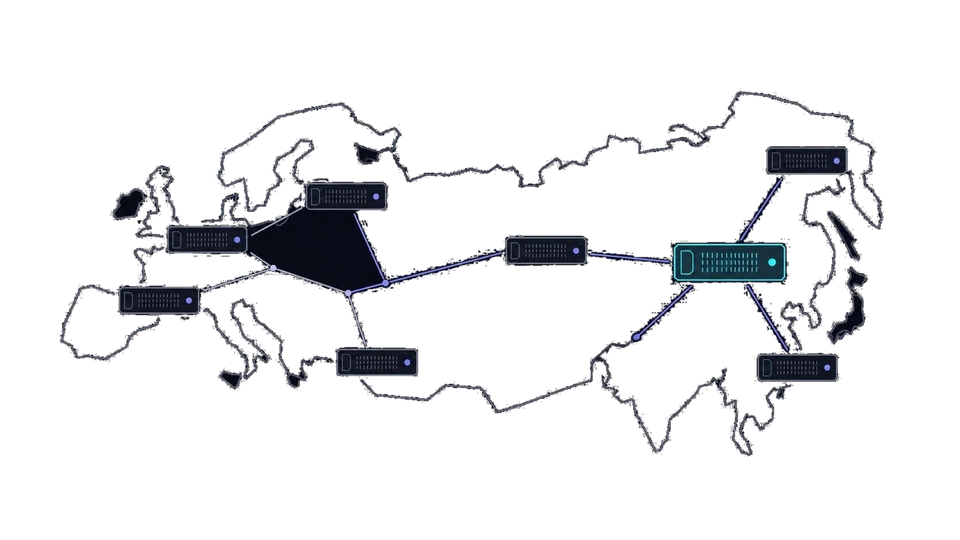
VPSbit is built around that exact separation, and the columns prove it. The racks stand in buildings with published tiers, uplinks and peering fabrics — Tier IV at 2N+1 in Luxembourg, 100 Gbps into DE-CIX Frankfurt, AMS-IX density in Amsterdam — while the Saint Kitts biller keeps every contract clear of the alliances' direct grip. GDPR still governs the Union sites, and nothing on this page claims otherwise; the contract simply never has to enter that courtroom. You pick each flag for its law and its latency, and the paper stays where you put it.
The Monero rail matters more here than newcomers expect, because a SEPA transfer or a card charge reopens a small dossier at your bank no matter how clean the hosting door was. Plastic is absent from this flow entirely. Nineteen assets settle instead, with XMR carrying headline status, and the Pay with Monero guide walks you through the month-after-month mechanics when you bill from inside the Union. If your threat model includes bank records, that absence is not a perk you negotiate for; it is the starting line.
- One biller: Meridian Node Ltd., Saint Kitts and Nevis
- One credential: a token, or email plus a 12-character password
- No passport, phone or card at any tier
- Nineteen coins settle the invoice, XMR first-class
None of this is poster-map marketing. The buildings answer to GDPR, to the Swiss FADP or to Norway's EEA implementation, and each regime is spelled out per site in the ordering flow before you pay a cent. What the separation removes is the contractual chokepoint: one foreign bill, a token or a mailbox-plus-password identity, and no scanned passport resting in a cabinet anywhere. Four sentences of architecture, and you can audit each of them against a published page — curated, closed-capacity hosting on named silicon, with the paperwork deliberately somewhere else.
The 2026 field: five hosts on one grid
Five shops make the shortlist because European buyers actually compare these five, not because the market stops here. Coverage in and around the Union, screening posture and money rails decide the outcome columns. The VPSbit row lists eight European-area flags — Amsterdam, Frankfurt, Luxembourg, Zurich, Stockholm, Helsinki and Oslo, plus Reykjavik just outside the Union — all behind one documents-free door and a coins-only bill. Every other row keeps the facts its publisher prints, down to the screening posture and the rail list.
| # | Host | Union-area sites | Screening | Money rails |
|---|---|---|---|---|
| 1 | VPSbit | 8: Amsterdam, Frankfurt, Luxembourg, Zurich, Stockholm, Helsinki, Oslo + Reykjavik (outside the Union) | None — token, or email + password | 19 coins, XMR first-class |
| 2 | FlokiNET | NL, RO (+ IS, FI) | None | BTC / XMR |
| 3 | 1984 Hosting | Iceland alone | None | XMR / BTC |
| 4 | Njalla | Sweden (kept vague) | None | XMR |
| 5 | Hetzner | DE, FI | Identification often requested | Plastic only |
Read the rows against each other and the texture appears. FlokiNET's Netherlands and Romania anchors are real, with Iceland and Finland extending the reach, and its BTC and XMR rails are what the site claims. 1984 Hosting gathers its entire operation on Iceland behind fifteen years of history. Njalla opens accounts cleanly but stays vague about where the machines sit — Sweden, unrevealed. Hetzner is the polished incumbent whose identity requests and plastic-only billing take it off anonymity-first shortlists, whatever its engineering deserves on its own merits.
Notice the pattern nobody breaks: each rival concedes a column outright. Njalla concedes map disclosure, FlokiNET concedes breadth, 1984 concedes the single flag, Hetzner concedes the paper trail. That arithmetic — four concessions against one complete row — is what the ordering encodes, not loyalty. For scale on the door price: VPSbit Core runs a $6 sticker and $4.80 on the twelve-month plan for 2 vCPU, 4 GB of DDR5 and 80 GB of NVMe, while bare-metal Forge lists at $49, or $39.20 yearly. Competing cells keep their published figures rather than converted guesses, and the smallest tag is rarely the smallest cost once an identification request can take an account away from you.
The leader's ledger: VPSbit weighed first
The house entry leads the grid, so its weaknesses print before anyone else's. Every line below comes from VPSbit's own pages or from the hole where a page should be, and the same standard binds this publisher first. A ranking that cannot criticize the company behind it is an advertisement wearing a table, and you deserve the ledger instead: strengths first, then the documented trade-offs in plain rows you can price.
- Eight Union-area flags under one Saint Kitts biller
- Documents never requested, at any tier
- Nineteen-asset billing with XMR first-class
- Core at $4.80 annual-eff on named Ryzen 9 9950X and EPYC 9354P dies
- Published tiers, uplinks and peering for every building
- Reykjavik +20%, Zurich +35%, Oslo +20%, Luxembourg +15% surcharges
- A single credential string; safekeeping falls on you
- Assistance runs on tickets, not a phone queue
In practice the trade-offs have shapes you can plan around. Moving flags is a fresh install, never a fresh negotiation — the base tag holds at most sites, and the four premium flags print their surcharges before you order. The single-string credential means the password manager and the offline copy are your responsibility from minute one, a discipline this page repeats deliberately. Ticket-based assistance trades the phone queue for a written record, which suits operators who want threads, not calls, when something breaks at 3 a.m.
Set this ledger against the four challengers below and one pattern holds: the concessions listed here are priced, published and plannable, while the concessions below are structural — hidden maps, single flags, plastic rails, identity requests. You should still weigh them yourself rather than take the ordering on faith. The grid gives you every number it used, and the deploy page lets you verify the door in about 60 seconds from payment to SSH before you commit a single coin to it.
The four challengers, weighed honestly
Four ledgers follow, weaknesses included, and each one traces to the seller's own pages rather than to forum folklore. The strengths print first, the documented trade-offs second, in the same order for every shop. Hold each row against the VPSbit ledger above it, and ask one question as you read: which concession would hurt your deployment first — the map, the flag count, the rail list, or the identity file?
FlokiNET brings genuine substance to the table: Netherlands and Romania anchors inside the Union, Iceland and Finland alongside them, no screening at the door, and a speech record that reaches back years. Its BTC and XMR rails are exactly what the site claims. The concessions are breadth and depth — the reach stops at four-plus flags, no per-building tier or peering depth is published at the level risk work wants, door pricing runs above this grid's leader, and paperwork routines slow the start in ways a coin bill never would.
- NL and RO anchors inside the Union
- IS and FI extend the map
- BTC and XMR both accepted
- A speech record reaching back years
- Reach stops at four-plus flags
- No published per-building tiers or peering depth
- Door pricing above this grid's leader
- Paperwork routines slow the start
1984 Hosting is the heritage pick, and paying for heritage is rational once you price the latency honestly. Fifteen years of Icelandic speech history, no screening, XMR and BTC taken — the story has weathered several European policy storms, and that record cannot be counterfeited by a newcomer with a nice domain. But one flag concentrates every project under a single roof, continental latency from Iceland taxes real users, no token lane exists, and the range stays cloud-shaped when your workload reaches for metal. You are buying jurisdiction depth, not footprint.
- Fifteen years of Icelandic speech history
- No screening at the door
- XMR and BTC both taken
- A record that survived European policy storms
- One flag concentrates every project
- Continental latency from Iceland taxes users
- No token lane exists
- Range stays cloud-shaped near metal
Njalla opens accounts cleanly and takes XMR, and its name recognition in the anonymity market was earned over years rather than bought with ads. The structural concession is placement: the machines sit in Sweden, admitted only vaguely, which blocks any building-level legal scoring from outside. The door sits near EUR 15, the VM range runs slim, and registration strength does not fully carry over to the server line. Before you commit anywhere, ask where your box will physically sit; a vague answer is an answer, and you should price it as one.
- A tidy registration narrative
- XMR accepted
- Brand recognition earned over years
- Placement admitted only as Sweden
- Door near EUR 15
- Slim VM range
- Registration strength does not carry to servers
Hetzner is the polished incumbent, and pretending otherwise would fail the honesty test this page runs on itself first. German and Finnish buildings at true scale, enterprise-grade network paperwork, steady plastic billing for conventional firms — all of it real. The concessions disqualify it for anonymity-first buyers: identification requests are routine at the door, every bill leaves a bank-side trace, and the GDPR story stops at buyers willing to show ID. For your purposes that closing line is the entire tale, however strong the engineering behind it is.
- DE and FI buildings at true scale
- Enterprise-grade network paperwork
- Steady billing for conventional firms
- Identification requests routine at the door
- Plastic only — every bill leaves a bank trace
- GDPR story stops at buyers who show ID
Notice again what the four ledgers share: each one is a good shop conceding one column completely. None of them is a scam, and none of them fills the sheet. When you rerun the weights with your own priorities, that pattern is the stable result — which is why the ordering above survives a one-axis glance that makes the race look tighter than the full grid shows. Your risk model decides which concession is fatal; the grid only makes sure you see it before you pay.
Anonymous VPS from $4.80/mo on the annual term. Core on Ryzen 9 9950X silicon across 12 elite locations, Monero billing, no KYC, no auto-charges — one invoice covers twelve months.
Choosing your flag: the eight European-area sites
Amsterdam and Frankfurt are the interconnection capitals, and they are the default whenever round-trip time rules your deployment. AMS-IX sits next door in Amsterdam with a 40 Gbps uplink; DE-CIX Frankfurt carries 100 Gbps. Both cities sit inside Eyes arrangements, and this page books that as a declared trade rather than a disqualification — you write the label into your ops notes, and the speed slot stays honest. Luxembourg counters with a Tier IV building at 2N+1, 40 Gbps into LU-CIX and AMS-IX, and a data-trust regime with functioning courts behind it.
- Amsterdam: Tier III+ / 2N, 40 Gbps, AMS-IX and DE-CIX
- Frankfurt: Tier III+ / 2N, 100 Gbps, DE-CIX Frankfurt
- Luxembourg: Tier IV / 2N+1, 40 Gbps, LU-CIX and AMS-IX, +15%
- Zurich: Tier IV / 2N+1, 100 Gbps, SwissIX and DE-CIX, FADP, +35%
- Stockholm: Tier III / 2N, 40 Gbps, NetNod and DE-CIX North
- Helsinki: Tier III / 2N, 20 Gbps, FICIX
- Oslo: Tier III+ / 2N, 20 Gbps, NIX, EEA GDPR, +20%
- Reykjavik: Tier IV / N+1, 10 Gbps, FICIX, no mandatory retention, +20%
Zurich and Reykjavik are the privacy-first flags beyond the Union, and both sit a single bounce from European users. Zurich pairs Tier IV space at 2N+1 with 100 Gbps into SwissIX and DE-CIX under the FADP; Reykjavik joins Tier IV at N+1 with 10 Gbps into FICIX and no obligatory data retention. Stockholm adds a Nordic edge under GDPR with a press-freedom heritage behind it, and rate discipline holds across the set: the base tag stands at eight of the twelve sites, with the four surcharges posted openly before you order a thing.
Fit the flag to the work, never to the poster. Helsinki and Stockholm issue Union IP addresses whose retention history reads lighter, which suits quiet EU-facing services; Frankfurt and Amsterdam take the milliseconds for speed-led roles; Zurich and Reykjavik hold the sensitive primaries. If a law-only view would help you decide, run the regimes above each box on their own sheet before you compare anything else, and take the Best VPS outside the 14 Eyes page next — it widens the alliance analysis beyond this continent with the same column discipline.
A two-box pattern that survives production
The arrangement that holds up in production uses two machines and one rule: separate IPv4 addresses, separate roles, labels in ink. A Zurich Titan at $24 sticker carries the password vault, WireGuard and mail submission; an Amsterdam Core at $6 serves the public static site that feeds on AMS-IX, booked plainly as the speed slot and never repainted as an alliance escape. Both bill to one account, so nothing new opens at the door, and the pattern survives price changes because it maps to how the work actually splits.

Keeping the split inside one account removes the bookkeeping that usually pushes people back toward a single oversize server: one coin balance, one panel, one invoice cycle. Monero settles both bills under the single Saint Kitts biller, the pair costs $30 at sticker or $24 on annual terms, and one credential set covers the two boxes. Reykjavik replaces Zurich whenever speech culture outweighs FADP procedure, at its own posted +20% surcharge. What never changes is the rule the whole pattern hangs on: one role, one address.
- Never let two roles ride one IPv4 address
- Sender standing cannot survive a shared address
- Snapshot both boxes; keep the rollback drill dull
- Label the Amsterdam trade in your ops notes
- Prices follow the machine, not the frontier
Keep a note of what each flag is for, stored beside the machine's ID in your encrypted manager: privacy primary on one side, AMS-IX replica under an explicit label on the other, a quiet Union-IP box in Helsinki or Luxembourg as the third slot when you need one. Renew in Monero, bill under Saint Kitts, and the same dollar rate applies in every datacenter — Core stays $6 and Titan stays $24 wherever you hang them. Decisions stay about courts and speed, never about promo tags, and a forced migration later will read your notes rather than your intentions.
Red flags: the slips Europeans repeat
The mistakes below repeat across the European privacy crowd with depressing regularity, so they get names instead of hints. You will recognize at least one from a forum thread you have read this month. Each one is cheap to avoid and expensive to discover, and the antidote is identical for all four: decisions in writing, made before pressure arrives, stored somewhere your later self will actually look for them.
- GDPR at the building mistaken for an exit from intelligence pacts
- One SEPA or plastic shortcut reopening a bank-side dossier
- Your own name left in Union WHOIS beside an anonymized server
- Surcharged flags dismissed as upsells rather than invoices with contents
Unpack the first two, because they do the most damage. GDPR governs how firms handle personal data; it says nothing about signals treaties between states, and a rack inside a GDPR country still sits inside whatever pacts its state has signed — two facts, two separate lines in your risk profile. The SEPA slip is quieter: shortcut signups are exactly what unravel a careful setup, because the bank record, the ID capture and the direct debit outlive the project that excused them. One exception is one exception too many, and the bank record does not expire on schedule.
The WHOIS slip needs one sentence: leaving your own name in a Union registry beside a carefully anonymized server lets a single lookup tie the two together, so registrant privacy stays on every domain you touch. The surcharge slip is the one that corrupts risk models — Reykjavik's +20% buys Tier IV at N+1 under a no-retention regime, and Zurich's +35% buys 100 Gbps into two peering fabrics under FADP oversight, so both are invoices with contents. Weigh them against a cut-rate rack in an alliance-core country and your price sheet stops doing the work of a risk model. Notes are cheap, migrations are not, and the boundary of what no-KYC hosting actually protects deserves one deliberate read before you lean a workflow on it.
Two axes, tuned separately: courts and milliseconds
One recurring tangle earns its own corner: tuning one axis and reporting the other, as though the two traded against each other. They do not. A host that wins speed loses nothing when you also need law, because the axes run independent — and this range is unusual in letting you take both under one bill. Settle the courts question first, since it moves least; set speed second, from your users' own measurements rather than from a wall map with cheerful colors on it.
The regimes across the Union-area flags, stated without decoration: GDPR in Amsterdam, Frankfurt, Luxembourg, Stockholm and Helsinki; the FADP beyond the Union in Zurich; the EEA implementation in Oslo; Iceland's own no-retention posture in Reykjavik. Building facts travel with the regimes — tiers from III to IV, uplinks from 20 to 100 Gbps, peering fabrics from AMS-IX to FICIX — and the ordering flow's site table prints every row in full before you commit. You are never left guessing which law sits over which iron, which is half the battle in this market.
The Saint Kitts biller stays fixed while you choose each machine for its courts or its speed, and you can twin the setup wherever it helps: Zurich primary with an Amsterdam replica is the house default, and Reykjavik with a Frankfurt replica answers the same shape for speech-first workloads. What you must never do is open a fresh dossier at a SEPA or plastic host for a single side project — not once, not for one quarter, not for one client with a deadline. The bank record outlives all three, and it never needed to exist at all.
Write down which axis you tuned, per machine, in whatever private notebook you keep. Half a year later the reasoning is not recoverable from an IP address, and incident reviews run on records rather than memory. The same documentation habit carries over to keys, endpoints and the other places where intent evaporates — write down what each secret opens, and revisit the list whenever a service joins the box, because habits like this cost minutes while repaying years. Your future self, migrating under a deadline, is the reader you are writing those notes for.
A concrete starter build for a European operator
Here is the build this page ships for an operator opening out. The plan is Core at $6 sticker — 2 vCPU, 4 GB of DDR5, 80 GB of NVMe — the money is Monero, and the site is Stockholm: the closest edge for Nordic and Baltic users, a building under Sweden's GDPR regime with NetNod and DE-CIX North on the fabric, and a Saint Kitts contract printed on every bill. Nothing in that sentence is aspirational; every clause is checkable at checkout before you fund anything.
- Open deploy and pick Core on the annual term
- Choose Stockholm, then the token or email-plus-password path
- Pay the live-rate Monero invoice from your own wallet
- Log in roughly 60 seconds after the payment clears
- Label the box, snapshot it, store the credential offline
An anonymous server with Union-side speed begins at $4.80 on the twelve-month plan, or Forge metal at $39.20 yearly once the work justifies 16 cores and twin NVMe. One credential string, one nineteen-asset menu and one documents-free funnel cover both ends of that span, which makes your opening decision the only genuinely hard one on the page. The order itself clears in roughly 60 seconds of clock, so the scarce resource is not deployment speed — it is the quality of the labels you write before the box exists.
Spend the saved seconds on what actually matters: the ops-note labels, the Monero renewal rhythm, registrant privacy on any domain you register, and a dashboard login that never rides the browser profile your daily identity uses. The sign up without email walkthrough shows the credential step at screenshots-level detail if you want the hand-held version, and the Anonymous VPS primer keeps the definitions straight from zero if the category is new to you. Boring routines are what make anonymous infrastructure durable, and every one of them is free of charge.
Related reading, grouped by the question you are actually asking. The Best cheap no-KYC VPS comparison tags the floor tier; the Best crypto-only VPS board scores the rails alone; the no-KYC VPS grid lines up full catalogs behind one documents-free door. On the practical shelf, the Buy a VPS with crypto primer covers settlement end to end, the VPS vs dedicated bare-metal comparison charts the upgrade points, and the Offshore VPS guide takes the entity questions that arrive with real assets.
Zurich primary, Amsterdam replica, one bill. Titan at $19.20 and Core at $4.80 on annual terms, Monero settlement, about 60 seconds from payment to SSH.
Does GDPR reach my server?
GDPR governs how firms handle personal data, while the contents of your machine answer to you alone. Building law stays local — GDPR at the Union flags, the FADP in Zurich — and the contract itself is Saint Kitts.
Which flag guards privacy best?
Reykjavik and Zurich answer to systems drawn up wholly outside the Union: no mandatory retention in Iceland, FADP judicial oversight in Switzerland. Inside it, Helsinki and Stockholm issue Union IPs with lighter retention pasts.
Can I settle in EUR?
Billing runs in USD and clears in coins only — XMR, BTC, ETH and USDT across seven networks inside a nineteen-asset set. SEPA and plastic never appear, so there is no bank-side trace and no screening at any processor.
Which flag should Union users treat as home base?
Zurich balances legal procedure against round-trip time best: Tier IV at 2N+1, 100 Gbps into SwissIX and DE-CIX, at a +35% posted surcharge. When speech protection and a no-retention stance outweigh the rest, take Reykjavik at +20%.
So is Amsterdam banned?
Not at all — book it as a speed slot and label it that way in your notes. AMS-IX density is real, the building runs Tier III+ at 2N with 40 Gbps, and a public site feeding on that peering belongs exactly there.
What about mail from a Union box?
Every plan opens port 25 with an editable PTR, so submission works from first boot. Two roles never share one IPv4 — the vault box and the public site keep separate addresses, and sender standing grows on the domain.
Primary sources
Ready to launch?
Build the box — VPS or bare metal — create the password, pay the invoice that follows.