 VPSbit
How to Register a Domain Anonymously
Four leaks tie a domain to you: registrar KYC, payment rail, public record, contact alias. Close each in one evening, then host it from $4.80/mo.
Four leaks tie a domain to you: registrar KYC, payment rail, public record, contact alias. Close each in one evening, then host it from $4.80/mo.
WHOIS privacy is not privacy: the four-leak model
The popular recipe — add a privacy flag, done — fails because a registration leaks four ways and the flag plugs one. The four: the registrar's own identity demands, the payment instrument, the public record itself, and the contact address attached to the domain. Any single leak re-identifies the other three, which is why a domain with a privacy shield and a card payment is anonymous in exactly the sense that matters least.
The model is worth internalizing because each leak has a different owner. The registrar owns what it demands of you; the payment network owns what the transaction says; the registry publishes what the rules require; and your own mailbox owns the trail of renewals and notices. Four separate custodians, four separate closures, and the domain ends up exactly as private as the weakest of them — there is no averaging and no partial credit.
| Leak | Custodian | Closure | Cost if skipped |
|---|---|---|---|
| Registrar KYC | The registrar | Proxy or no-KYC model | Identity on file, compel-ready |
| Payment rail | Bank / processor | Crypto from self-custody | Permanent statement line |
| Public record | The registry | Redaction or proxy name | Archived exposure |
| Contact address | Your mailbox | Dedicated alias | Cross-service correlation |
Timing is the other half of the model: leaks are cheap to close at registration and expensive to close after the record has a history, because history is what observers correlate. A domain name moved to privacy today still carries five years of public snapshots in archives, zone-file scrapes, and certificate logs. The closures cost an evening on day one and a court case on day one thousand — pick the evening, every time.
Closures, in order: a registrar whose model never collects identity answers the first; a crypto payment from a wallet you control answers the second; proxy registration or full redaction answers the third; and a purpose-made alias answers the fourth. The record speaks RDAP now rather than raw WHOIS — the protocol moved, the exposure logic did not — and a single lookup against your domain returns registrar, dates, and status codes in JSON in under a second. Run that query against your current domains and count the fields you would rather not publish; that count is this guide's to-do list, and doing 3 of the 4 closures leaves the fourth holding the whole weight.
VPS from $4.80* — Core on the annual term (list $6/mo), one invoice for 12 months, no auto-charges. Dedicated with IPMI from $39.20/mo. Crypto invoice, no KYC.
Launch nowRegistrar models: proxy registration versus a privacy flag
Two registrar architectures dominate the privacy conversation, and they differ in who owns the domain — a question most buyers never think to ask. Conventional registrars put the record in your name and hide it behind a privacy service; proxy registrars put the record in their own name and license the use to you. The public record looks equally clean under both; the custody question underneath is not, and it decides outcomes when it matters most.
The proxy model's strength: the registrar itself never learns who you are, so there is no database of your details to compel, breach, or misuse — Njalla is the known example, accepting XMR and BTC while holding the record on your behalf. The conventional model's strength: you are the registrant of record, with the legal standing that implies, and the privacy service is a layer you can drop. A privacy flag on a conventional registrar blanks the public field but keeps the registrar's file — a difference that matters precisely when it matters most.
- Proxy: registrar never holds your identity; abuse path runs through support.
- Conventional plus flag: you are registrant; registrar still keeps a file.
- Recovery: test the ownership proof path before an emergency tests it.
- Transfers: expect harder questions than the public record ever asks.
Registries and GDPR complicate the map. Many European country-code TLDs redact registrant data at the registry level, so the public record is thin regardless of any flag; thin is not absent, since the registrar and registry still hold what they hold, and ccTLD rules differ per country. gTLDs follow the RDAP model from the previous section: fields exist, redaction varies, and the privacy service decides the difference. Status codes such as clientTransferProhibited tell you the rest of the operational story at a glance.
Where it breaks: mixing models mid-life. A domain bought under your name 5 years ago does not become private by toggling a flag today — the history in archives and zone-file scrapes predates the toggle and stays public regardless. Choose the model deliberately at registration; if the domain predates the plan, treat its history as public and decide whether that matters for the workload. Whatever the model, keep the registrar relationship alive: log in quarterly, confirm the contact alias still forwards, and read the notices before they become expiries.
The payment rail outlives the domain
Domains are rented; payments are forever. A card statement line for a registrar charge sits in your financial records long after the domain has expired and been forgotten. Of the four leaks, the payment is the only one whose record you do not control, cannot redact, and cannot delete — which makes it the one to design around first, and the one most people design around last.
The closure is the same discipline the hosting checkout uses: pay in Monero or BTC from a self-custody wallet, so no bank statement, no processor, and no merchant record ties a legal identity to the purchase. Monero hides the sending side entirely; Bitcoin is public but breaks the link to your name when the wallet is not yours on paper. A card payment does the opposite permanently — it is the one closure you cannot retrofit afterward, at any price, on any schedule.
- Rail: XMR or BTC from a wallet you control, funded before you begin.
- Margin: hold roughly 10% above the invoice figure for rate drift.
- Renewals: draw from the crypto balance on file, never a card.
- Calendar: a manual renewal check beats a surprise auto-charge.
- Hosting: same rail as the domain, one payment identity end to end.
Renewals inherit the rail you choose. Auto-renew draws from the same source every cycle, so a single card-funded renewal reattaches your name years after a careful crypto registration. Set renewal to draw from the crypto balance on file and calendar a manual check instead — a two-minute habit that keeps the financial record as quiet as the registration was, cycle after cycle, with no anniversaries for anyone to subpoena.
Run hosting through the same rail the domain used: take Core at $6/mo list, $4.80 annual-eff, pay it in the coin you registered with, and the whole chain from name to server carries one payment identity instead of two. Mixed rails — private domain, card-hosted server — reintroduce exactly the join this guide exists to break, and they do it silently, at the layer nobody rechecks. Where it breaks in practice: convenience top-ups, because a wallet drained mid-registration gets refilled from whatever is fastest, and the fastest source is usually an exchange account in your name.

The contact address is the leak nobody plans for
Registrars, hosts, analytics tools, and mailing lists all ask for an email, and the domain's contact address quietly becomes the master key to the other three leaks: one alias reused across two services correlates them permanently. The fourth leak is entirely self-inflicted, which makes it entirely fixable — and entirely common, because the fix is a discipline rather than a purchase.
The closure is an alias used for nothing else: created at registration, used at the registrar, the host, and the DNS provider, and nowhere else in your life. Modern aliasing — catch-all domains, forwarding services, per-service addresses — makes the cost near zero. What matters is the discipline: the alias never intersects daily mail, never appears on a resume, and never subscribes to a newsletter, because correlation is the product of reuse, not of the address itself.
- Scope: registrar, host, DNS provider — and nothing else, ever.
- Naming: a project-style inbox (reg-dom-2026@) over anything name-bearing.
- Autoresponder: disabled; one vacation reply undoes three closures.
- Forwarding: self-hosted on a box you control beats a free service.
- Backup reminder: a calendar entry, not a second email.
- Audit: yearly, the list of services holding the alias stays memorizable.
Naming helps more than it should. An alias that reads like a project inbox survives years of neglect without inviting replies to your name, while a name-bearing alias defeats its own purpose in the first message. Treat the address as operational infrastructure — neutral, documented in your own notes, replaceable — rather than as an identity, and the alias becomes one more credential in the rotation instead of one more thread to pull.
Renewal mail is the reason the alias must be watched: notices, expiry warnings, and transfer confirmations all land there, and an unwatched alias is how private domains die — the renewal section covers the drop-catch aftermath in detail. Keep the alias forwarding somewhere you actually read, keep a second reminder in a calendar rather than in email, and prefer self-hosted forwarding on a box you control, because free forwarding services shut down and yours cannot be revoked by anyone else. Where it breaks: the autoresponder that offers a real address in one line, handing over what three sections of this guide protected.
DNS: third-party nameservers versus your own box
DNS is the quietest of the four leaks and the one people outsource without a thought. Every third-party nameserver relationship is another account with your identity attached, another holder of zone data, another database that can be compelled or breached. The zone itself is public by design — the question is who holds it, and what else that holder knows about the person who pays them.
Three architectures exist, in rising order of control: the registrar's free DNS, a third-party DNS service, and your own authoritative server on a small annual slice. The registrar's DNS keeps everything in one custody chain but couples the domain's availability to the registrar; a third-party service adds resilience and one more account; your own box answers to nobody's account database at all. Split the roles if you would rather not run everything — neutral DNS under an anonymous account for availability, your own box for the records you rotate.
- Architecture one: registrar DNS, single custody, coupled availability.
- Architecture two: third-party service, resilient, one more account.
- Architecture three: your own authoritative pair, no account database.
- Delegation: at least 2 nameservers, enforced by registrars.
- Verification: query a public resolver, then the nameservers directly.
Running your own authoritative DNS is a half-day project: install the server, publish the zone with its A and AAAA records, hand two glue names to the registrar, and watch propagation. Knot DNS or NSD make the configuration a page rather than a chapter, with a single conf file as the whole surface for the latter. Propagation waits are the only slow step — budget an hour for delegation changes and test with a resolver you do not operate, because your own cached answers lie politely.
Where it breaks: single points of absence. A one-box authoritative setup goes down with the box, so pair it — two slices in two locations, or one self-hosted primary plus one third-party secondary — and the zone survives either failure. DNS availability is the whole game here: a private domain that does not resolve is a private nothing, and mail records are the next thing that story has to tell. Confirm delegation from the outside before you call it done: a stranger's path through DNS must reach your box without touching the old holder.
Mail in scope: SPF, DKIM, DMARC without branding yourself
The moment a private domain sends mail, it starts generating evidence, and most of it is hostile: fresh domains carry no sender reputation, and inbox providers treat anonymity as a synonym for spam until proven otherwise. Publishing SPF, DKIM, and DMARC is not optional — it is the difference between unproven and forged, which is how filters read the same header with and without those records.
The records, briefly: SPF names the IPs allowed to send for the domain, DKIM signs the mail with a key published in TXT records, and DMARC tells receivers what to do when the first two disagree. All three are public; none of them identify you — they identify the mail. Start with p=none and rua reporting, watch a week of aggregate reports, then tighten the policy as the data arrives and the failures make themselves known.
- SPF: the sending IPs, one TXT record, kept minimal.
- DKIM: 2048-bit or Ed25519 keys, rotated a few times a year.
- DMARC: p=none with rua first; tighten on a week of data.
- rDNS: PTR matches the HELO name, static IP, warmed volume.
- Selectors: public by design; the private key stays on the host.
Rotation is the part guides skip: DKIM keys deserve the same treatment as SSH keys — rotated a few times a year with old selectors kept for verification, and the private half living on the sending host and nowhere else. That quietly couples this section to host discipline in general: a box that leaks its keys leaks its mail identity with them. Edit the PTR from your host's panel so the reverse story matches the forward one, because deliverability leans on that match.
Behavior outranks records in the end. A domain that starts by mailing its first thousand addresses lands in spam regardless of records; one that accumulates consent and volume over weeks climbs without tricks. Where it breaks: cold mail. Unsolicited volume from an anonymous domain is the fastest route to both spam lists and an abuse report, and the second one arrives at the facility under its law — the acceptable use policy bans spam in terms that do not bend for enthusiasm. If the growth plan requires cold outreach, buy the outreach a second domain, and keep the private name for infrastructure.
Renewal calendars: how private domains actually die
Private domains almost never die of compromise; they die of calendars. The alias goes unwatched, the renewal silently fails or silently succeeds on a dead payment source, and the name drops into the drop-catch market — where a new owner buys its entire history: backlinks, mail reputation, and whatever the public archives remember. A lapsed private domain is a de-anonymized one with a reader, and the reader did nothing but wait.
History is the asset the drop-catcher buys: years of mail reputation, inbound links, certificate-transparency logs naming subdomains, and archives of every page that ever existed. Certificate logs deserve special mention — every TLS issuance is public forever, so subdomains you considered private years ago are still enumerable, and log viewers make the search a single box. Privacy at registration does not retroactively erase history; it only stops the history from growing.
- Expiry: the date lands in your calendar at 30 and 7 days.
- Grace: registrar grace period, then roughly 30 days of redemption at a fee.
- Release: after that, automated drop-catch bidders own the market.
- Funding: auto-renew draws from the crypto balance, never a card.
- Term: a 5-year registration turns an annual failure into a rare one.
The mechanics have a shape you can rehearse: expiry, then a registrar grace period, then a redemption grace period of roughly 30 days at a recovery fee, then release to the drop-catch market. Each stage is recoverable until the last one, at prices that climb steeply; after release, recovery is a purchase from strangers at whatever the market says. gTLD policy sets the bones of that timeline, and registrars decorate it with reminder emails to the address on file — the alias, if you followed the fourth section.
The closure is boring and mechanical: auto-renew funded from the crypto balance on file, calendar reminders at 30 and 7 days that do not depend on email, and a yearly audit that the alias still forwards. Multi-year registration narrows the window further at the price of more capital sitting in one registrar's custody; balance those, because there is no free side of the trade. Where it breaks: the payment side — a card that expired, an exchange account that closed, a wallet that was swept. Renewals fail silently exactly when nobody is looking, so pair the automation with the calendar and make the domain's death a decision rather than an accident.
Hosting that matches the discipline
The same minimum-data logic that bought the domain should run the box behind it, because the host is the registrar's sibling leak: a KYC-heavy host reattaches in one signup everything the proxy registration removed. Hosting is where the four-leak model gets audited in practice — the record says one thing, and the box's custody says whether it is true. The audit takes 10 minutes and answers binary questions.
Ownership shows up in odd corners: whose nameservers answer, whose PTR tells the mail story, whose account holds the TLS renewals. Each is a small custody question with a yes-or-no answer — yours or someone else's. Run it against the live domain, not the plan, because defaults accumulate, and each one is a leak with a date on it, quietly older than the last security post you read.
- Signup: a token, or email plus a 12-character password — nothing else.
- Checkout: crypto-only across 19 coins, live-rate invoice.
- Logs: no payload or guest traffic logs; connection metadata kept 24h or less.
- Panel: rDNS editable, so the mail story stays yours to tell.
- Network: DDoS filtering included, unmetered ports standard.
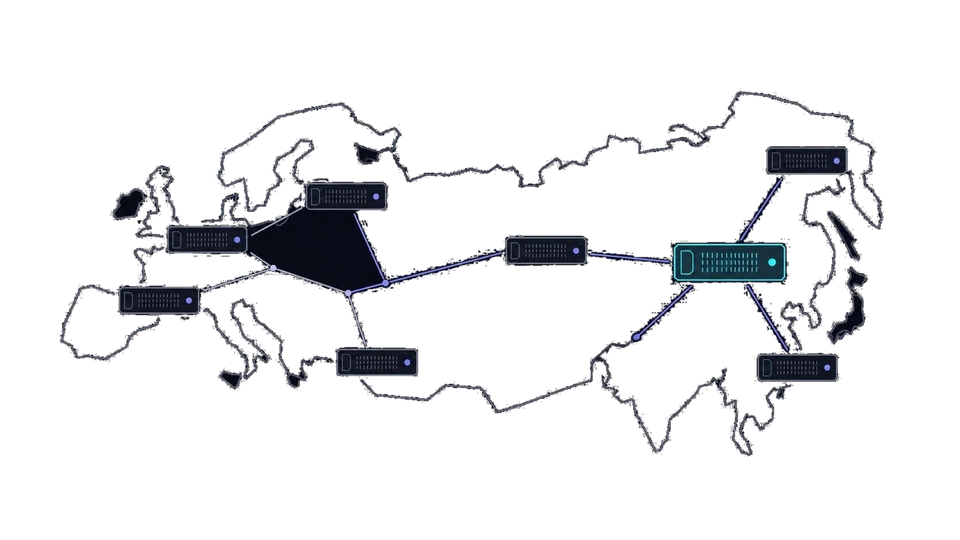
Then the physical map: 12 locations from Reykjavik to Taipei, each with a published tier, uplink, and governing law — the jurisdiction decision the domain does not make for you. Iceland carries a published +20% premium and Switzerland +35%; every other flag stays at base list, from Amsterdam and Frankfurt to Tokyo, Singapore, and Hong Kong. Abuse handling follows the law of the facility location, which is exactly why the location choice is a privacy decision and not only a latency one.
Point the record at a Core slice — $6/mo list, $4.80 annual-eff — paid in the coin the domain was registered with, so name and server share one payment custody. If the workload grows into mail, databases, or metal, the same checkout prices Forge at $49/mo list ($39.20 annual-eff) with IPMI for out-of-band access, under the same rules and the same invoice. Where it breaks: DNS on the registrar by default, which couples your availability to their uptime and adds one more identity-adjacent database. Move the zone or split it as the DNS section described, and the custody chain closes end to end.

The anonymous domain, in the order to run it
Order of operations, registrar first. Choose the model — proxy registration or conventional with privacy — create the alias that will touch nothing else, and register from a self-custody wallet in Monero or BTC, funded with a margin above the figure. The record now says what you intended it to say, and the calendar holds the expiry date twice: once in the panel, once where you will actually see it.
- Registrar: pick the model, mint the alias, pay from self-custody crypto.
- DNS: decide zone custody; delegate at least 2 nameservers.
- Records: A and AAAA first; SPF, DKIM, DMARC only if mail is in scope.
- Hosting: minimum-data account, matching rail, location whose law fits.
- Mail and calendar: alias forwarding, DMARC reports, reminders at 30 and 7 days.
- Audit: run an RDAP query, read as a stranger, fix what surprises you.
DNS second: decide custody of the zone — registrar, neutral service, or your own authoritative pair — and delegate at least 2 nameservers before anything else. Set the A and AAAA records for the names the domain actually needs, publish SPF, DKIM, and DMARC if mail is in scope, and leave every other field empty until something real demands it. Emptiness is a feature at this layer; every record is a public sentence about how you work, and fewer sentences are harder to misread.
Hosting third: the box under the domain takes the same minimum-data account — token or email, crypto-only invoice — in the location whose law fits the workload, with the premium sites priced accordingly and the other flags at base. Edit the PTR from the panel so the reverse story matches the forward one, then let propagation finish while you verify with a query from a resolver you do not operate, because your own cache lies politely. The no-KYC VPS requirements page details what that checkout collects and what it never asks for.
Fourth, the mail and the calendar: alias forwarding to an inbox you read, DMARC reporting to the alias, reminders at 30 and 7 days independent of email, auto-renew drawing from the crypto balance. Fifth, the audit: run a lookup against the finished domain, read what a stranger reads, and fix whatever surprises you — the audit is the only step that never stops being useful, because defaults creep back. Run in that order, the four leaks stay closed without heroics, and the domain becomes what it should have been all along: a name on the internet with nobody's name inside it.
Host the private name on the same rail you registered it with: Core at $6/mo list ($4.80 annual-eff), 12 locations from Reykjavik to Taipei, crypto invoice across 19 coins, no KYC. Open deploy, pick the plan, pay the invoice that follows.
Launch nowCan I register the domain directly at VPSbit?
No — this company sells hosting, not registrations, and mixing the two trades is how custody chains blur. Bring the domain from a registrar whose model fits the four-leak plan, point it at the server, and let the two halves hold each other to the same standard; the checkout and the proxy registrar answer different leaks, and both need closing.
Is WHOIS privacy enough on its own?
It blanks the public record while the registrar still holds your details, and privacy databases can be compelled or breached like any other. Proxy registration is the stronger architecture because the registrar never learns who you are; combined with a crypto payment and a dedicated alias, it closes all four leaks rather than one.
Does the hosting provider see my domain?
It sees what DNS points at the server — hostnames arrive in TLS handshakes and HTTP requests, the same as at every host on the internet. No-KYC governs what identity documents change hands, and in this checkout that set is empty on both sides, which is the honest version of the answer.
What breaks first in practice?
Renewals and mail. Domains lapse when the alias goes unwatched or the payment method quietly fails, so set auto-renew from the crypto balance, calendar reminders independent of email, and a second reminder somewhere you actually look. Mail deliverability is the second struggler — SPF, DKIM, DMARC records and a matching rDNS close it.
Is RDAP better than WHOIS for checking my exposure?
RDAP is the current protocol — structured JSON, consistent fields, per-registrar endpoints — while raw <a href='https://en.wikipedia.org/wiki/WHOIS'>WHOIS</a>, defined in RFC 3912, is the older free-text protocol it replaced. For your purposes they answer the same question: what a stranger's query returns. Run the lookup, read it as a stranger would, and redact whatever surprises you.
Do registry rules force identity collection everywhere?
No — the accreditation system lets registrars choose what they collect beyond the registry minimum, which is why proxy models exist at all; <a href='https://en.wikipedia.org/wiki/ICANN'>ICANN</a> contracts govern gTLDs while ccTLDs set their own rules per country. Read your registrar's demands against the four-leak model before checkout, not after the record exists.
Primary sources
More ways to pay
Pay with Bitcoin · Pay with Monero · Pay with USDT (TRC-20/ERC-20/SPL) · Pay with Litecoin · Pay with Ethereum · Pay with Solana · Pay with x402 · Pay with Dogecoin · Pay with XRP · Pay with TRX · Monero on bare metal · Dedicated servers with crypto · Pick the jurisdiction first.
Ready to launch?
Build the box — VPS or bare metal — create the password, pay the invoice that follows.